
The first person you fly after your licence is almost never a stranger. It is a parent, a sibling, a best friend, someone who trusts you completely and knows nothing about how to get out of an aeroplane.
That trust is exactly why the passenger safety brief is the item new pilots are most tempted to skip. It feels formal and slightly embarrassing to lecture your own mother about the door handle, so you wave it away, and in doing so you remove the one thing that would help her survive a bad day.
This is the brief done properly, in plain language, for the flights Kenyan pilots actually make. Circuits with a friend at Wilson, a hop up to Nanyuki, or a full load of safari passengers you have never met climbing in at a Mara strip.
The Short Version
- The passenger brief is a Pilot in Command responsibility, not an optional courtesy, and it is required by regulation for commercial operations and expected airmanship for private ones.
- The widely taught SAFETY brief covers Seatbelts, Air and environment, Fire equipment, Exits, Traffic and talking, and Your questions, in that order.
- Two lines decide survivability more than any other: how to release the seatbelt under stress, and where the exit is and how to open it.
- The sterile cockpit idea comes from airline regulation, and a smart single pilot borrows it: no non-essential chat during taxi, takeoff, climb, approach and landing.
- Brief every passenger every flight, including the ones who have flown with you before, because familiarity is exactly when the door gets forgotten.
- In dual-control trainers the "hands and feet off the controls" line is not optional, and at bush strips your brief has to cover a hot prop, spinning blades and where to walk.
Why this is not optional, and who says so
Let us settle the "is it really required" question first, because it changes how seriously you take it. For commercial air transport, a passenger safety briefing is a regulatory requirement, built into the operating rules that Kenyan commercial operators fly under within the ICAO framework.
For a private flight with you and a friend, no inspector is standing on the ramp. The responsibility does not disappear though, it simply moves onto you as Pilot in Command, whose job is the safety of everyone on board from the walkaround to the shutdown.
So the honest framing is this. The brief is legally mandatory for the safari charter and morally and practically mandatory for the flight with your cousin, and the pilots who treat those two situations differently are the ones who get caught out.
Here is the single opinion this article will defend. If you would run the brief for a paying stranger but skip it for someone you love, you have the logic exactly backwards, because the stranger has probably flown before and your cousin has not.
The SAFETY brief, line by line
You do not need to memorise a script, you need a structure you can run the same way every time. The most widely taught structure in general aviation is the SAFETY brief, and each letter is a thing your passenger genuinely needs.
Seatbelts. Show them how to fasten and tighten it, and then, more importantly, show them how to release it. Light-aircraft belt buckles differ from a car, and a passenger who cannot find the release while hanging in a harness after a forced landing is a passenger who does not get out.
This is also where you deal with loose items. A heavy camera or an unsecured bag becomes a missile in turbulence or a heavy landing, so it gets stowed and strapped now, not held on a lap.
Air and environment. Point out the fresh-air vents and the cabin heat, because a hot, stuffy cabin is the fastest route to a sick passenger on a bumpy Rift Valley afternoon. Show them the sick bag and, plainly, how and when to use it, because a passenger who is embarrassed and quiet is worse than one who is prepared.
Fire equipment and first aid. Show where the fire extinguisher and first aid kit live. On a longer sortie into remote country this ties directly into the survival and emergency equipment the aircraft is required to carry, and your passengers should know it is there.
Exits. This is the line you rehearse until it is smooth, because it is the one that saves lives. Show each passenger the nearest exit, how the latch and handle actually work, and make it explicit that the door stays shut in flight and is only opened on your command after everything has stopped.
Traffic and talking. Willing eyes are useful, so tell a capable passenger how to report traffic to you clearly, by clock position and rough height. In the same breath, set the rule for silence, which brings us to the sterile cockpit.
Your questions. Finish by inviting questions, and mean it. A passenger who nodded along without understanding the door is a hazard you built yourself, and thirty seconds of "what is not clear" fixes it.
The sterile cockpit, borrowed for one pilot
The phrase "sterile cockpit" comes from airline regulation, where crews are barred from non-essential conversation during the busiest and lowest phases of flight. It exists because a distracting chat on short final has killed professional crews who should have known better.
You are not an airline, but the human brain in your single-seat-of-command is the same one. A single pilot who is being asked about the view while lining up a crosswind landing at Wilson is a single pilot with less attention than the moment demands.
So borrow the principle and brief it in advance. Tell your passengers, before start, that when the aeroplane is moving on the ground, taking off, climbing away, or coming in to land, you will go quiet and so should they, and that normal chat resumes in the cruise.
Framing it beforehand is what makes it work. A passenger who has been told "I will stop talking on the approach, it is normal, do not worry" stays calm, while one who has not been told thinks something is wrong the moment you go silent.
The two lines in dual-control trainers
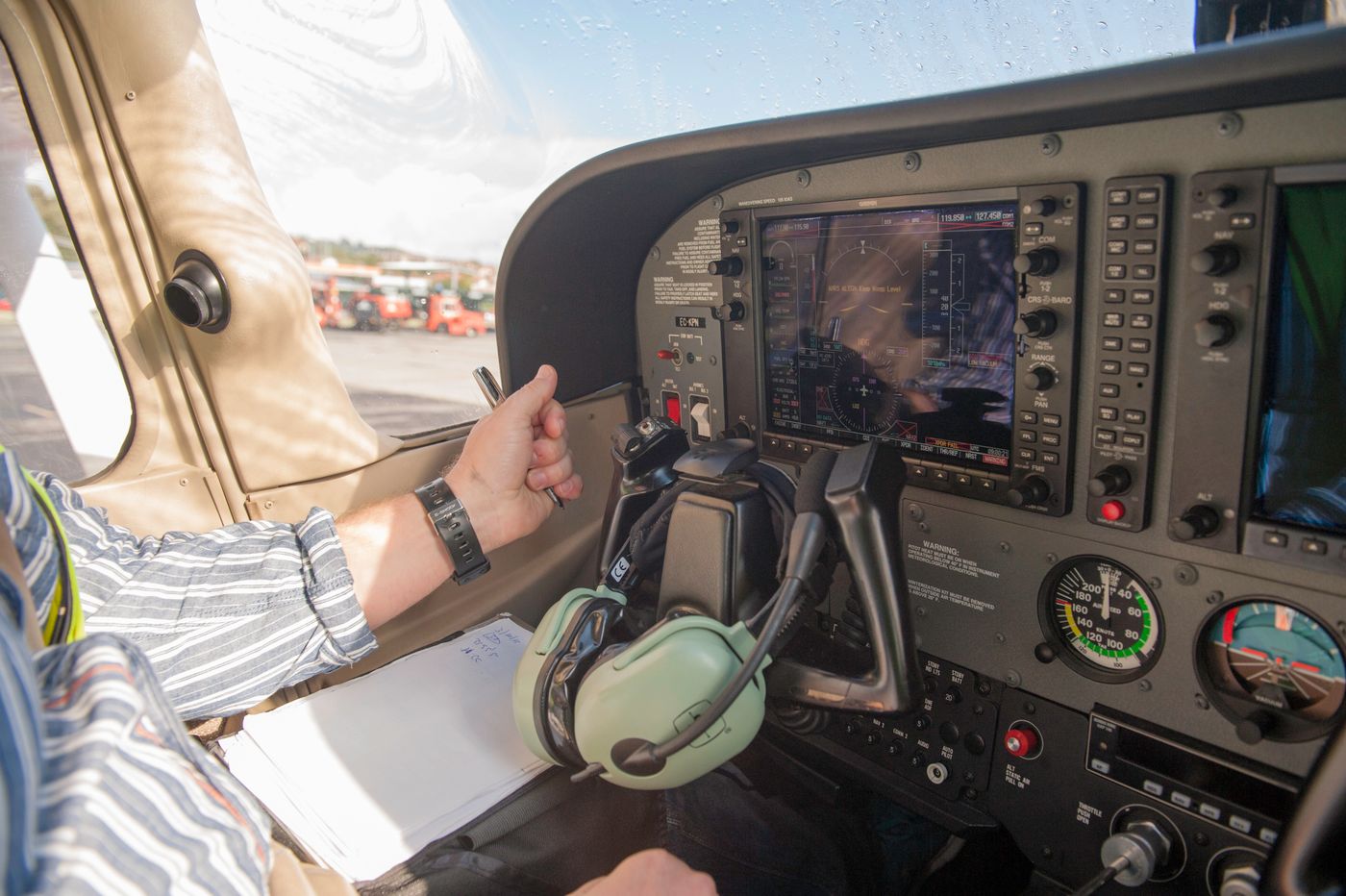
If your passenger is sitting where an instructor normally sits, there is a full set of controls in front of them. A yoke, rudder pedals and a throttle, all live, all connected to yours.
Brief it directly and without apology. Hands off the yoke and throttle, feet flat on the floor and clear of the rudder pedals, and do not grab anything if you get startled, because an instinctive clutch at the controls on final is exactly the wrong reflex at exactly the wrong moment.
This is the general-aviation version of a rule you already know from crew flying and single-pilot discipline. It connects to the wider habit of managing everyone and everything in the cockpit, the subject of single-pilot resource management, where an untrained passenger is a resource and a threat at the same time.
The bush-strip brief the textbook forgets
The standard brief assumes a tidy apron and an air-stair. A Mara or Laikipia strip assumes none of that, so your brief grows to fit the environment.
Before anyone gets out or in, deal with the propeller. A warm engine and a turning or recently turning prop is invisible and lethal, so passengers are told to approach and leave the aircraft only from behind the wing, on your signal, never toward the nose.
Cover the ground too. Where to walk, to keep clear of other traffic and animals near the strip, and to wait until you have shut down rather than stepping out into a live scene. These are the same non-flying passengers who make safari loads, and they will do exactly what you brief and nothing you leave out.
The fuel and the aircraft got your discipline on the walkaround, in the fuel drain check and the rest of the pre-flight. The people deserve the same, because in a bad day it is the brief, not the airframe, that decides who walks away.
Frequently asked questions
Is a passenger briefing actually required in Kenya?
For commercial air transport it is a regulatory requirement within the ICAO framework Kenyan operators fly under. For a private flight it is the Pilot in Command's responsibility rather than a document an inspector checks, but the duty of care is the same.
What does the SAFETY brief stand for?
Seatbelts, Air and environment, Fire equipment, Exits, Traffic and talking, and Your questions. It is a widely taught general-aviation structure, and the exact wording matters less than covering every letter.
Do I really need to brief someone who has flown with me before?
Yes. Familiarity is precisely when the door briefing gets skipped, and an emergency does not care that your passenger has flown ten times if they have never once been shown the exit latch.
What is the single most important item?
The two that most affect survivability are the seatbelt release and the exit. A passenger who can release the harness under stress and knows how to open the door is a passenger who can get out of a survivable accident.
Key Takeaways
- The passenger brief is a Pilot in Command duty, mandatory by regulation for commercial flights and by airmanship for private ones, and skipping it for people you love is the logic backwards.
- Run the SAFETY structure every flight: Seatbelts, Air and environment, Fire equipment, Exits, Traffic and talking, and Your questions.
- The seatbelt release and the exit are the survivability lines. Rehearse them until they are smooth and never rush them.
- Borrow the sterile cockpit: brief passengers before start that you go quiet during taxi, takeoff, climb, approach and landing, so your silence never reads as panic.
- In dual-control trainers brief hands and feet off the controls, and at bush strips add the propeller, the approach path and where to walk.
AngaBrief's pre-flight assessment can prompt you to confirm the passenger brief was actually given rather than assumed, alongside the rest of the human-factors picture before a flight. It does not brief your passengers for you and it does not clear the flight. That responsibility stays with the Pilot in Command and the instructor.