
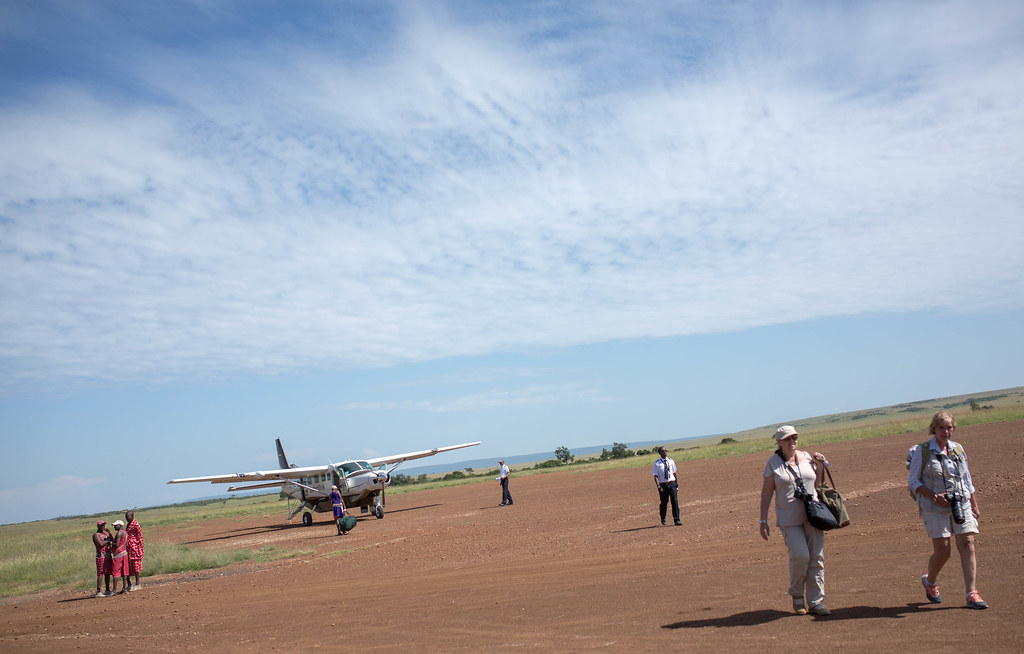
The Masai Mara is where a lot of Kenyan pilots first fly passengers who are not their instructor. It is also where the gap between "I can land a C172" and "I can land a C172 here" becomes obvious. The strips are short, the surface is murram, the elevation sits around 5,000 ft, and the runway may have zebra on it. None of that is in your PPL syllabus in a way that prepares you for the real thing.
The strips are not runways, and they do not pretend to be
Ol Kiombo, Keekorok, Musiara, Angama, Kichwa Tembo. Most Mara strips are unlicensed, unattended, and unmarked beyond a windsock and a shed. There is no tower, no fuel you can rely on, and no one to call if the surface is soft after overnight rain.
That means the aerodrome data you would normally read off a plate is your job to gather. Strip length, surface state, slope, obstacles, and the animals do not update themselves. You confirm them by radio with operators already on the ground, and you overfly before you commit.
Overfly. Every time. No exceptions.
A low pass at circuit height is not showing off. It is the only way to see what the strip is actually doing today:
- Is the surface dry, or is there standing water and soft murram from last night?
- Which way is the windsock pointing, and how hard?
- Is there game on or beside the strip? Wildebeest and zebra bolt in unpredictable directions.
- Are there vehicles, other aircraft, or people near the threshold?
Then position for the direction that gives you into-wind and, where the strip slopes, favours landing uphill and departing downhill. On a short strip at Mara elevation, getting that decision wrong is not a go-around you always have the performance to make.
Density altitude does not care that it is only 5,000 ft
People think density altitude is a Nanyuki or Mount Kenya problem. It is a Mara problem too. A hot afternoon at 5,000 ft field elevation can push your density altitude past 8,000 ft. Your C172 climbs like it is tired, your ground roll stretches, and a short strip that was comfortable at 8 a.m. is marginal at 2 p.m.
Plan Mara departures for the morning where you can. If you are stuck with an afternoon slot, run the numbers honestly: reduce weight, use the full strip, and accept that the book figures assume a pilot flying the exact numbers, on a good surface, with no wind gradient off the tree line.
The wildlife factor is real, not a postcard
A herd near the strip is a live hazard, not scenery. Animals that look settled on your overfly can be on the runway by the time you are on short final. If you see game close to the strip, a low pass to move them is normal and expected. If they will not clear, you do not land. There is no prize for putting an aircraft into a wildebeest.
The Short Version
- Mara strips are unlicensed and unattended. You gather the aerodrome data yourself, by radio and by eye.
- Overfly at circuit height before every landing. Surface, wind, slope, and game change hour to hour.
- Treat density altitude as a real performance limit even at 5,000 ft, especially in the afternoon.
- Game on or near the strip is a no-land condition until it clears. Fly the go-around early, not late.
- Confirm fuel before you leave. Mara fuel is arranged, not assumed.
The Mara rewards the pilot who treats every arrival as its own decision and punishes the one who treats it like a licensed aerodrome. Build the brief before you take off, and let the strip tell you on the overfly whether today is a yes.
Key Takeaways
- Every Mara arrival is a fresh go/no-go decision made on the overfly, not on the ground before departure.
- Uphill landing, downhill departure, into wind: get the direction decision right on a short murram strip.
- Morning slots beat afternoon slots for density altitude and surface state.