
There is a category of general aviation accident that has been thoroughly understood, extensively trained, and consistently not prevented. The stall-spin accident in the base-to-final turn (or on approach at low altitude) kills pilots at approximately the same rate in every decade of aviation. The aerodynamics are well-understood. The training syllabus addresses it. The accidents continue.
Understanding why this is the case, and what specifically changes the odds, is more useful than another recitation of the stall aerodynamics you already know from ground school.
The aerodynamics, briefly
A stall is a condition in which the wing exceeds its critical angle of attack and lift reduces abruptly. The critical angle of attack is constant for a given aerofoil: it does not change with airspeed, weight, or bank angle. What changes is the airspeed at which the critical angle is reached.
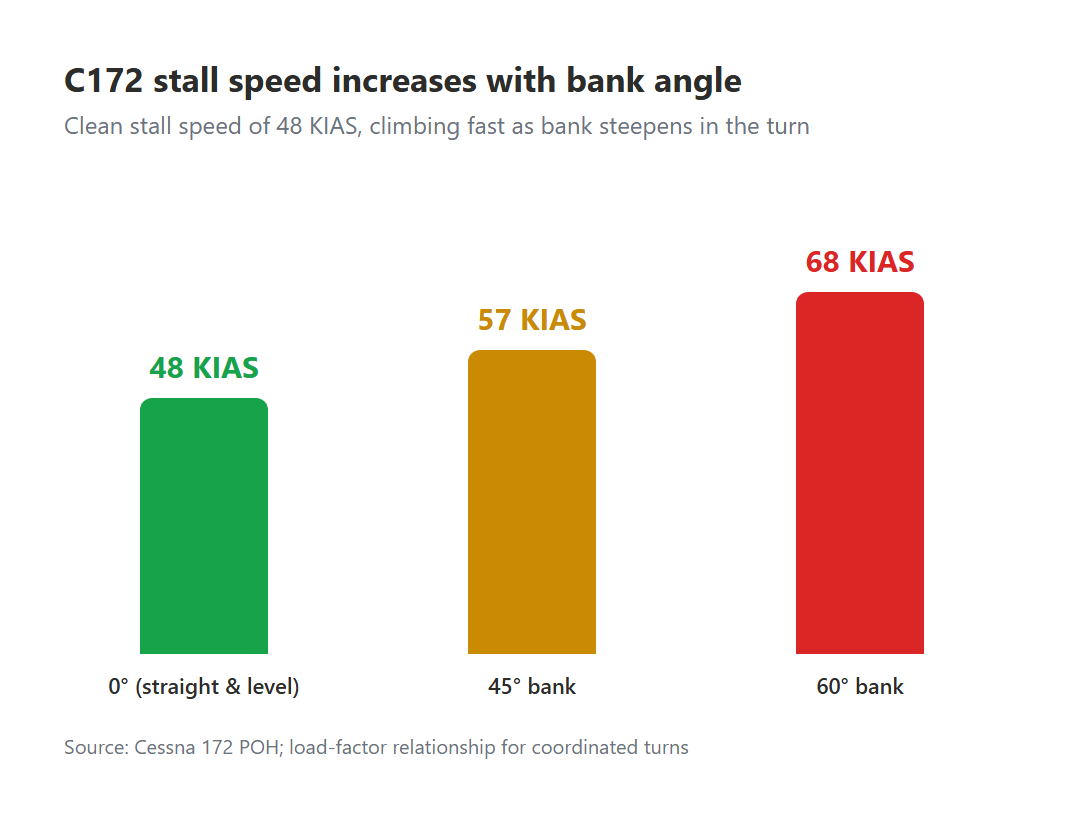
Stall speed increases with the square root of the load factor. In a 60° banked turn, the load factor is 2G, and stall speed increases by approximately 41% over the straight-and-level figure. For a C172 with a clean stall speed of 48 KIAS, a 60° bank raises the stall speed to approximately 68 KIAS. A 45° bank gives approximately 57 KIAS. These are indicated airspeeds: the actual risk in the circuit is real and calculable.
The base-to-final turn is where this becomes lethal. A student who overshoots the centreline on turning final and instinctively increases bank to correct will:
- Increase the load factor and therefore the stall speed
- Simultaneously add back pressure to maintain altitude in the turn, further increasing angle of attack
- Possibly apply rudder to tighten the turn (skidding the aircraft), which creates an asymmetric stall condition: the down-going wing stalls first, the aircraft rolls further into the bank, and an incipient spin develops
This happens at circuit height, typically 500-800 ft AGL. At that altitude, there is not enough time or height to recover from a developed spin. The aircraft contacts the ground.
Why training does not reliably prevent it
Flight training teaches the stall in safe conditions: altitude is adequate, entry is deliberate, recovery is practised. The student is mentally prepared. The aircraft is in a known configuration. The stall itself feels different from a stall in the base-to-final turn for several reasons:
Surprise. The base-to-final stall is not deliberate. The student is focused on the runway, on the correction, on the radio, on sequencing, not on monitoring angle of attack. When the stall occurs, the cognitive processing time for recognition and correct response is compressed to under a second.
Instinctive response is wrong. The instinctive human response to unexpected pitch-down and roll (which is what a stall in a bank feels like) is back stick and opposite aileron. Both are incorrect. Back stick deepens the stall. Opposite aileron at low speed in an asymmetric stall situation can worsen the roll toward the stalled wing. The correct response (forward stick, coordinated rudder to stop the yaw, level the wings, power) is counterintuitive and requires trained automaticity to execute correctly under surprise.
The training environment vs the real environment. Training stalls are conducted with altitude, with a prepared mental set, with an instructor. The base-to-final situation occurs with maximum cognitive load (approaching, sequencing, crosswind), minimum altitude margin, and maximum surprise. The gap between "I practised this in training" and "I can execute it correctly under these conditions" is where accidents live.
The specific risk factors at Wilson Airport
Wilson's circuits create several specific base-to-final risk conditions:
- Tight sequencing in a busy circuit creates pressure to turn final sharply to maintain sequence position, which leads to overshooting the centreline
- Afternoon crosswinds from the northeast push aircraft downwind on base, causing them to fly further than planned and making the final turn more demanding
- The grass Runway 07R is short relative to the tarmac 07, and a student perceiving they are "long" on final may attempt to steepen the approach through a sharper final turn
- The go-around decision hesitation described in other contexts also applies here: the instinct is to correct the overshoot rather than go around
What actually changes the risk
Two things have demonstrable effect on stall-spin accident rates:
Angle-of-attack awareness. Pilots who understand that stall is an angle-of-attack event (not a speed event) and who monitor angle of attack as a primary parameter during approach have better outcomes. In a bank, the question is not "am I above stall speed in straight-and-level flight?" but "what is my angle of attack right now, given the load factor in this turn?" Practising this mental model in every circuit makes it automatic.
The decision rule for overshooting final. If you overshoot the centreline on turning final at Wilson, the correct response is to go around. Not to increase bank. Not to apply top rudder to skid the aircraft around. The decision rule must be pre-set, decided before the overshoot happens, so that when it happens, the response is already determined. The go-around mental model applies here exactly: if you are not aligned and established by a defined point, you go around. No deliberation.
Personal minimums for bank angle on final turn. Many experienced pilots set a maximum bank angle on the base-to-final turn, commonly 30°. If the final turn requires more than 30° of bank to achieve alignment, they go around. This rule is simple, teachable, and verifiable. It prevents the situation from developing rather than requiring heroic recovery technique.
What to take into your next circuit session
Before your next circuit session, set the following personal rules:
- Maximum 30° bank on the final turn. If alignment requires more, go around.
- Monitor approach speed on final: any trend below the target speed is corrected immediately with power, not attitude alone.
- If any doubt about stabilisation by 500 ft AGL, it is a go-around. No deliberation.
These rules replace in-the-moment judgement with pre-set decision criteria. They are exactly the kind of risk mitigation that the External pressures section of your PAVE assessment asks you to consider: are you operating to a clear, predetermined standard, or are you making it up as you go?