
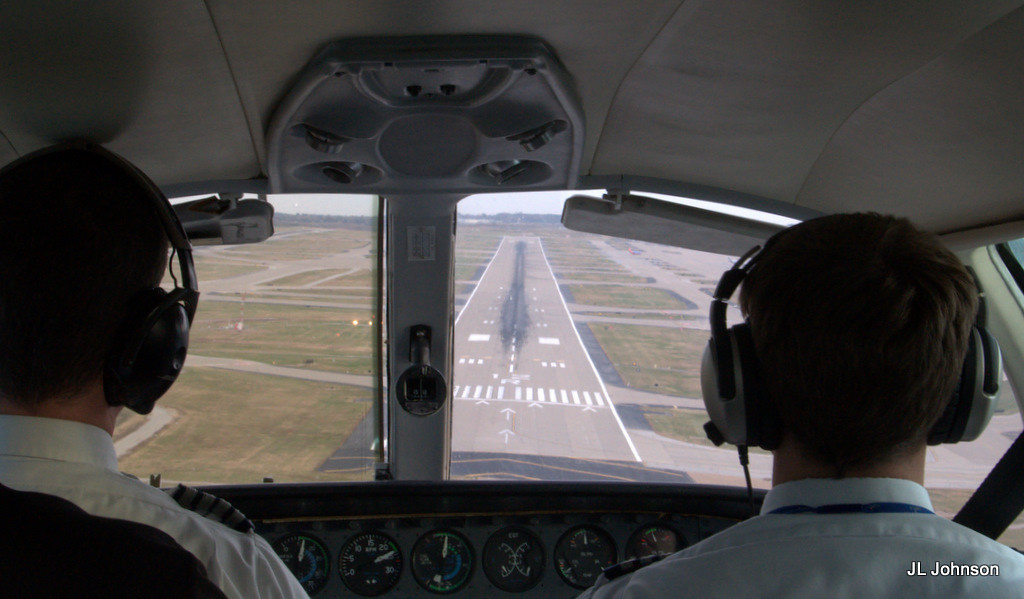
The go-around is the most underused safety procedure in general aviation. Accident data consistently shows that a significant proportion of landing accidents (runway excursions, hard landings, ground loops, undershoots) were preceded by an unstable approach that the pilot continued to land rather than going around. The pilot knew something was wrong. The aircraft was telling them something was wrong. They continued anyway.
Understanding why this happens, and training yourself out of that tendency, is one of the most important things you can do in your early flying career.
What an unstable approach looks like
Your flight school and the KCAA syllabus define a stabilised approach by specific criteria. The typical standard for a VFR circuit in a light aircraft:
- On the correct approach path (on glideslope or VASI indication if available) by 500 ft AGL
- At the correct approach speed (+/− 5 knots)
- Correct configuration (flap setting, landing checks complete)
- Correct power setting for the phase of approach
- Aligned with the runway centreline
- Stable rate of descent (not increasing dramatically)
If any one of these criteria is not met by 500 ft AGL in VMC conditions, the correct action is to go around. Not to correct on short final. Not to try harder. To go around.
Common unstable approach scenarios at Wilson's grass circuit:
- Turning final too close, requiring a steep bank to align: speed decays, altitude is low, you are slow on a bank in close to the ground
- Overshooting the centreline on final and correcting in steps: each correction changes energy state and approach path
- Carrying excess speed to the threshold: floating, using up runway, still not down at the point where a go-around is becoming unviable
- Crosswind correction inadequate: touching down with drift, yaw on contact with the runway surface
Why student pilots hesitate to go around
Research into pilot decision-making identifies several cognitive factors that combine to suppress the go-around decision.
Plan continuation bias. You have set up for a landing. The whole circuit was aimed at that landing. Abandoning the plan feels like failure, psychologically, not rationally. The bias toward completing the planned action is strong enough to override the sensory data telling you the approach is not right.
Social and performance pressure. Going around in front of an instructor, or in a busy circuit with other aircraft, or when the school radio is monitoring, feels like a public admission of inadequacy. It is not, but the feeling is real and it suppresses the go-around decision.
Perceived cost asymmetry. The go-around feels like it costs something: another circuit, more fuel, more time, more effort. The unstable landing feels like it might work out. This asymmetry is irrational (the potential cost of a runway excursion at Wilson is vastly higher than one more circuit), but the emotional weighting in the moment is real.
The "almost there" illusion. At 200 ft on an unstable approach, the runway is right there. It looks close. It seems like whatever is wrong can be corrected in the last few seconds. In reality, 200 ft at normal approach speed gives you approximately six seconds to flare and land. Six seconds is not enough time to correct a significantly unstable approach.
The mental model that works
The most effective mental model for building a reliable go-around decision habit is to treat the go-around as the default, not the exception. Rather than "I will land unless I have to go around," reframe as "I will go around unless everything is correct by 500 ft."
This is not a subtle semantic difference. It changes the decision from reactive (something goes wrong, I respond) to proactive (I am monitoring against criteria, and if any criterion fails, the default action is already determined). The proactive framing eliminates hesitation because there is no decision to make in the moment: the decision was made in the planning phase.
Practise saying it aloud in the circuit: "500 feet, speed correct, on path, stable, continuing." Or: "500 feet, high, going around," and then go around without further deliberation. Your instructor will notice this discipline immediately, because many students never develop it.
Executing the go-around correctly
A go-around is not an emergency. It is a normal manoeuvre that happens to be executed at a critical phase of flight. The standard C172 go-around procedure:
- Call "Going around" on the radio immediately
- Full power, smoothly but without hesitation
- Establish a positive climb attitude: approximately 10° nose up
- Retract carburettor heat (if applied)
- Retract flaps progressively as the aircraft accelerates: one stage at a time, confirm positive rate of climb before each retraction
- Climb to circuit height, re-join the circuit, re-establish the sequence with ATC
Common errors during go-around execution: retracting all flaps simultaneously (causes rapid loss of lift before airspeed increases), failing to call ATC immediately (causes separation issues in the circuit), and relaxing the climb attitude before a positive climb rate is established (results in striking the runway or obstacles with the aircraft in a nose-up attitude).
After the go-around: the debrief
Every go-around is information. Use the subsequent circuit to understand what drove the unstable approach. Was it the turn onto base: too early, too late, too steep? Was it the wind correction on final: inadequate allowance for the crosswind component? Was it the speed management in the descent?
The IMSAFE component of your pre-flight assessment is also relevant here. A fatigued pilot makes worse approach decisions. A distracted pilot fails to stabilise as early. If the go-around was driven by poor cognitive performance rather than pure technique, that is worth noting and discussing with your instructor.
The go-around is not a failure. It is proof that your decision-making system is working. Every go-around that prevented a runway excursion is indistinguishable from a perfect landing: the outcome is the same, the aircraft is undamaged, and you will fly again tomorrow.