Ask ten people what a PPL costs in Kenya and you will get ten different numbers, and most of them will be technically true. That is the actual problem. Flight training fees in Kenya are not standardised, not always itemised the same way, and rarely quoted with the same inclusions. Before you hand over a deposit, you need to know what you are comparing, not just the headline number.
What nine schools actually charge for a PPL
Here is a real comparison, gathered from published fee information for Wilson Airport and Nanyuki-based schools:
- Mt. Kenya Flight School (Nanyuki): KES 750,000 – 1,000,000
- Proactive Training Services (Wilson): KES 800,000 – 1,000,000
- Skymax Aviation (Wilson): KES 800,000 – 1,100,000
- Ninety Nines Flying School (Wilson): KES 850,000 – 1,100,000
- Valentine Air Services (Wilson): KES 850,000 – 1,100,000
- Kenya School of Flying (Wilson): KES 900,000 – 1,200,000
- Nairobi Flight Training Ltd (Wilson): KES 900,000 – 1,200,000
- Westrift Aviation (Wilson): KES 900,000 – 1,200,000
- Flight Training Centre (Wilson): KES 1,000,000 – 1,300,000
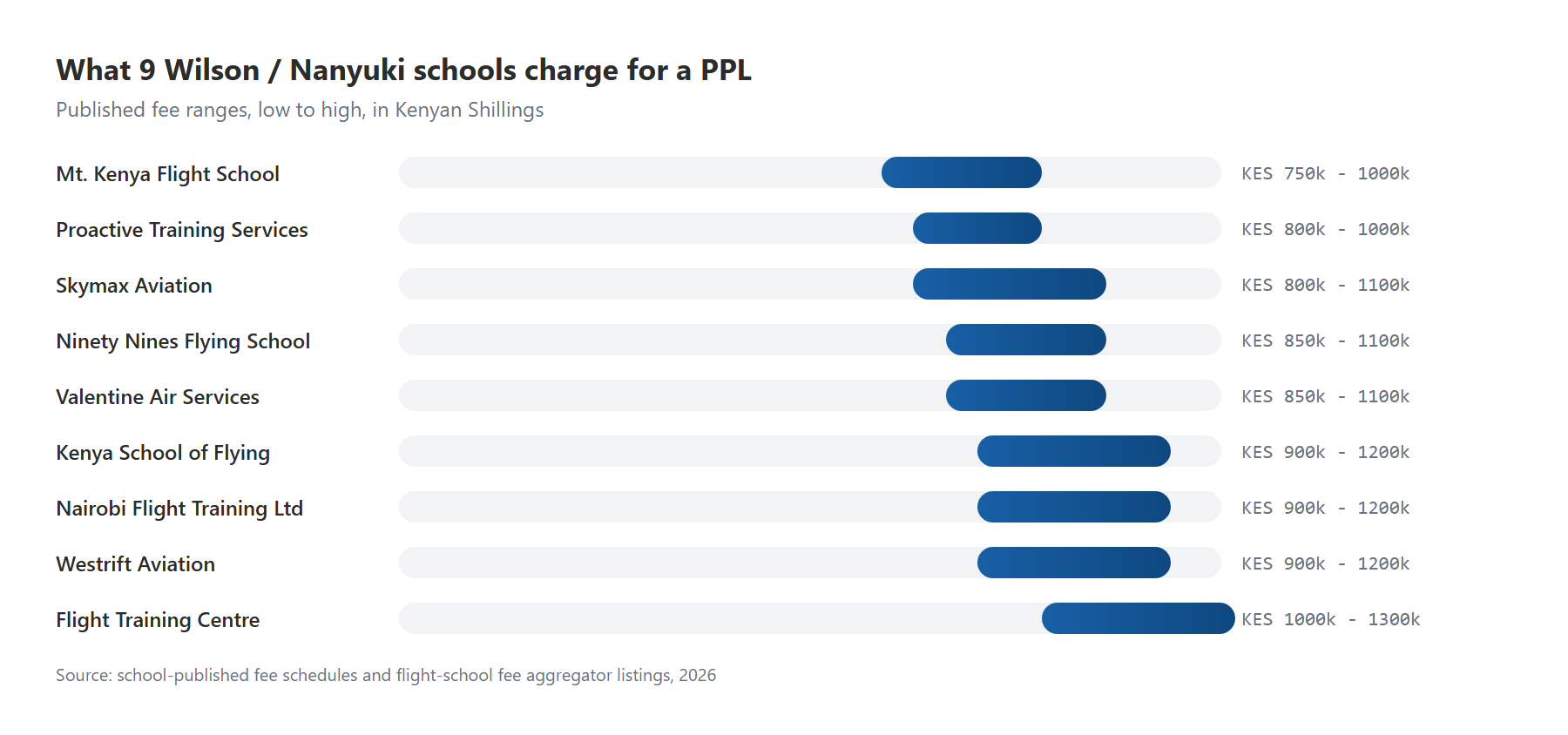
That is a spread from 750,000 to 1.3 million shillings for the same licence. Same KCAA syllabus, same 40-hour regulatory minimum, same Class 2 medical requirement. The aircraft are mostly the same type too: Cessna 172s and Piper Cherokees dominate the Wilson fleet. So why does the price move by half a million shillings depending on which school you walk into?
Why one school's own number does not match the aggregator's number
Here is where it gets interesting, and where most comparison articles stop being honest with you. Kenya School of Flying's own published programme page, not a third-party listing, breaks its PPL course down to roughly USD 14,467 all-in: that is close to KES 1.87 million at current rates. The aggregated range above puts the same school at KES 900,000 to 1.2 million.
Both numbers are real. They are just not measuring the same thing. The school's own breakdown includes line items that a quick KES range almost never does:
- 50 flying hours at USD 210/hour, not the 40-hour regulatory minimum
- Ground school tuition as a separate line, not bundled into the headline figure
- Stationery, equipment, and uniform
- An iPad with a ForeFlight subscription
- A first aid course
- Air navigation service charges
- KCAA's own regulatory fees: GFT booking, ground exams, radio and English proficiency, licence application
- The examiner's fee, paid directly and separately
None of that is hidden or dishonest. It is just not in the headline number, because the headline number is built on the 40-hour regulatory minimum and excludes the kit. Almost nobody actually finishes a PPL in exactly 40 hours (more on that below), so the realistic figure is always higher than the quoted minimum.
The KCAA minimums you are actually paying to meet
Strip away the marketing and here is what KCAA actually requires for a Private Pilot Licence in Kenya: you must be at least 17 years old, hold a valid Class 2 medical certificate, demonstrate English language proficiency, complete a minimum of 40 flying hours, and pass a skill test before the licence is issued. To keep the licence current afterward, you need 5 hours as pilot-in-command in the preceding 12 months.
Forty hours is the floor, not the average. Most students need more: weather cancellations, a slower-than-planned progression to solo, retaken stages, and simple individual variation in how quickly people get comfortable in the circuit all push real flying time above the regulatory minimum. Budget for 50 to 55 hours if you want a number that will not embarrass your spreadsheet halfway through training.
The costs that catch people off guard
Exam retakes. KCAA's ground examinations are not designed to be easy, and the pass mark is 75%. If you fail a subject, there is a waiting period before you can retake it, and you pay the exam fee again. Study properly the first time. It is cheaper than the alternative in money and in months.
Going over your booked hours. Schools quote a package built on the minimum or a planning average. If your progression is slower, the extra hours are billed at the standard hourly rate, which at Wilson currently runs in the region of USD 200–220 per hour depending on the school and aircraft. That is roughly KES 26,000–28,000 per additional hour at current exchange rates: five extra hours is over KES 130,000 you did not plan for.
The medical. Get your Class 2 medical done in week one, not when your instructor says solo is close. A failed or delayed medical does not just cost the exam fee: it costs weeks of training calendar while the school's aircraft and instructor time keep ticking on your invoice regardless.
Kit you did not budget for. A tablet with a current aviation app subscription, headset, and basic flight bag are not optional extras in 2026: they are how training actually happens. If a school's headline figure does not mention them, ask directly whether they are included.
How to actually compare two quotes
Do not compare headline numbers. Ask every school you are considering for the same itemised breakdown: hourly rate and the hour count it assumes, ground school fee, kit and equipment, KCAA regulatory fees (these are largely fixed regardless of school), and the examiner's fee. Once you have that broken down the same way for two or three schools, the real comparison appears, and it is usually a smaller gap than the headline numbers suggested.
Ask what happens if you need extra hours beyond the package. Ask whether ground school is self-study, scheduled classes, or one-on-one: this affects both the fee and how fast you actually learn the theory. Ask how many of their recent students finished within the quoted hour count, not how many finished "around" it.
Where the real value sits, beyond the price tag
A cheaper quote that costs you ten extra hours because instruction was inconsistent is not actually cheaper. Training efficiency comes from the things a price list does not show you: how rigorously your instructor reviews your pre-flight decision-making, how consistently your training is logged and reviewed between sessions, and whether your school catches a developing bad habit at hour 8 instead of hour 25.
This is the part of training cost nobody puts on a fee schedule, and it is the part AngaBrief is actually built around. Every PAVE assessment you complete is timestamped and visible to your instructor, which means a developing pattern (rushed pre-flight checks, a recurring weak spot in weather decision-making) gets caught early instead of at your skill test. Early correction is cheaper than late correction, in hours and in money.
The bottom line
Budget KES 900,000 to 1.3 million for a realistic, no-surprises PPL at a reputable Wilson Airport school in 2026, inclusive of the extra hours almost everyone needs beyond the 40-hour minimum, kit, and KCAA fees. Anyone quoting meaningfully under that figure is either quoting the bare regulatory minimum with nothing else included, or you need to ask very specifically what is missing. Get every quote itemised the same way before you compare them, and start your Class 2 medical the day you decide to start training, not the day before your instructor says you are ready to solo.