
Getting your Student Pilot Licence (SPL) from the Kenya Civil Aviation Authority is the first formal regulatory step in your training journey. Without it, you cannot act as pilot-in-command even with an instructor on board, and you certainly cannot fly solo. Many student pilots underestimate how long the administrative process takes and find themselves ready to solo but waiting on paperwork. This guide covers every step in the correct sequence.
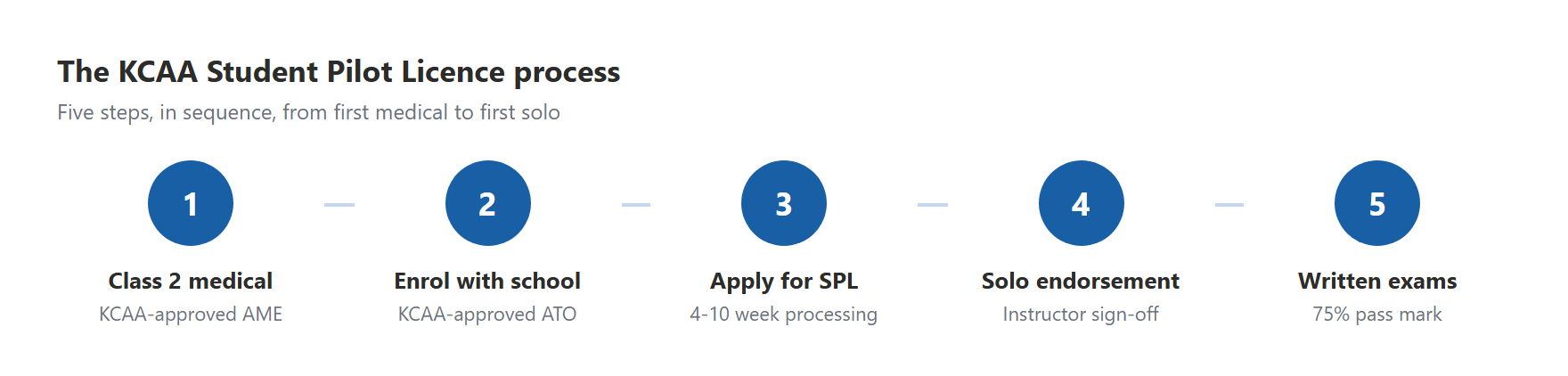
Step 1: Class 2 medical certificate
The KCAA Class 2 medical is a prerequisite for everything else. You cannot apply for an SPL without a valid Class 2 certificate. The medical must be conducted by a KCAA-approved Aviation Medical Examiner (AME): your flight school will have a list of approved AMEs, most of whom are based in Nairobi.
The Class 2 examination includes:
- Vision assessment (corrected or uncorrected visual acuity must meet KCAA standards)
- Colour vision test (Ishihara plates, colour deficiency can restrict your licence or disqualify you from certain ratings)
- Hearing assessment
- Cardiovascular examination including ECG (for certain age groups)
- Neurological assessment
- Urine analysis and basic blood work
Common issues that cause SPL delays: undiagnosed hypertension, borderline colour vision deficiency, and vision problems that require aviation-standard spectacles rather than standard prescription glasses. Get the medical done before your first flight lesson, not after you have accumulated 10 hours of training: discovering a medical issue late wastes training fees and creates a difficult situation with your school.
The Class 2 certificate is valid for 24 months if you are under 40, and 12 months thereafter. Keep it current: a lapsed medical means a lapsed licence, and you cannot fly legally without both.
Step 2: Enrol with a KCAA-approved flight school
You must train at a KCAA-approved Approved Training Organisation (ATO). Flying with an individual instructor who is not operating under an ATO is not legally valid for licensing purposes. Your school will have a KCAA approval certificate displayed on the premises: verify this before paying any fees.
At enrolment, the school will require:
- Certified copy of your national ID or passport
- Copy of your Class 2 medical certificate
- Passport-sized photographs
- Training agreement / school registration forms
Step 3: Apply for the Student Pilot Licence
Your school's administration office will assist with the KCAA SPL application, or you can submit directly to the KCAA Licensing Department at Wilson Airport. The application requires:
- Completed KCAA Form CA/FCL/001 (Student Pilot Licence Application)
- Copy of your valid Class 2 medical certificate
- Certified copy of identification (ID or passport)
- Two passport photographs
- Application fee (confirm current fee with KCAA directly, fees are subject to revision)
Processing time at KCAA varies. In routine periods, allow four to six weeks. During busy periods or examination seasons, allow eight to ten weeks. Submit early. Your school can issue a training authorisation letter allowing you to continue dual instruction while the SPL is being processed, but solo flight requires the physical SPL in hand with the solo endorsement signed by your instructor.
Step 4: Solo endorsement
The SPL alone does not authorise you to fly solo. Your instructor must make a specific solo endorsement in your SPL and in your training logbook before your first solo flight. This endorsement certifies that in the instructor's professional judgement, you are competent to fly the specific aircraft type solo under the specific meteorological conditions applicable that day.
The endorsement is route-specific and conditions-specific for early solo flights. Your first solo will be circuits at your home aerodrome under good VMC. As your training progresses, the instructor will endorse you for local area solo flights, then for solo cross-country navigation exercises to specific aerodromes.
For the instructor, the solo endorsement decision is one of the highest-stakes judgements in training. The PAVE assessment for a solo flight should be completed by the student and reviewed by the instructor before the endorsement is given on the day. Weather conditions, aircraft serviceability, and the student's IMSAFE state are all assessed as part of this process.
Step 5: Ground study and the KCAA written examinations
The PPL pathway requires you to pass KCAA written examinations in the following subjects:
- Air Law and Procedures
- Navigation
- Meteorology
- Aircraft Technical Knowledge (Airframes, Engines and Systems)
- Flight Performance and Planning
- Human Performance and Limitations
- Communications
- Principles of Flight
You do not need to wait until you finish flying training to begin these examinations. Many students study and sit written examinations concurrently with flight training, which is the recommended approach: understanding the theoretical basis for what you are doing in the cockpit accelerates your practical learning significantly.
Examination dates are published by KCAA periodically. Register in advance. Examination slots fill up. The pass mark is 75% for each subject. Subjects may be retaken individually if failed, but there is a waiting period between attempts.
Common mistakes that delay the process
Leaving the medical too late. Some students book the medical only when the instructor tells them solo is imminent. A six-week KCAA processing delay then prevents the solo from happening for two months. Book the medical in week one.
Not keeping a copy of all documents. KCAA licensing involves physical paperwork. Documents get lost. Keep certified copies of everything you submit and do not hand over originals unless explicitly required.
Letting the medical lapse. A lapsed Class 2 medical voids your SPL and PPL until the medical is renewed. Diarise the renewal date from the day you receive the certificate.
Flying beyond the SPL endorsement scope. The endorsement is specific. If you are endorsed for circuits at Wilson and you fly a solo navigation exercise to Naivasha without a navigation endorsement, you are operating outside your authorisation: a regulatory violation, not just an oversight.
What AngaBrief does for student pilots going through this process
The pre-flight assessment system is active from your first dual training flight. Every assessment you complete with an instructor is logged in the system, creating a timestamped record of your training progression. Your instructor can see your assessment history when making endorsement decisions. The structured PAVE/IMSAFE framework you practise in AngaBrief from day one is the same framework the KCAA expects you to apply throughout your career: building the habit early makes it automatic by the time you are flying solo.