
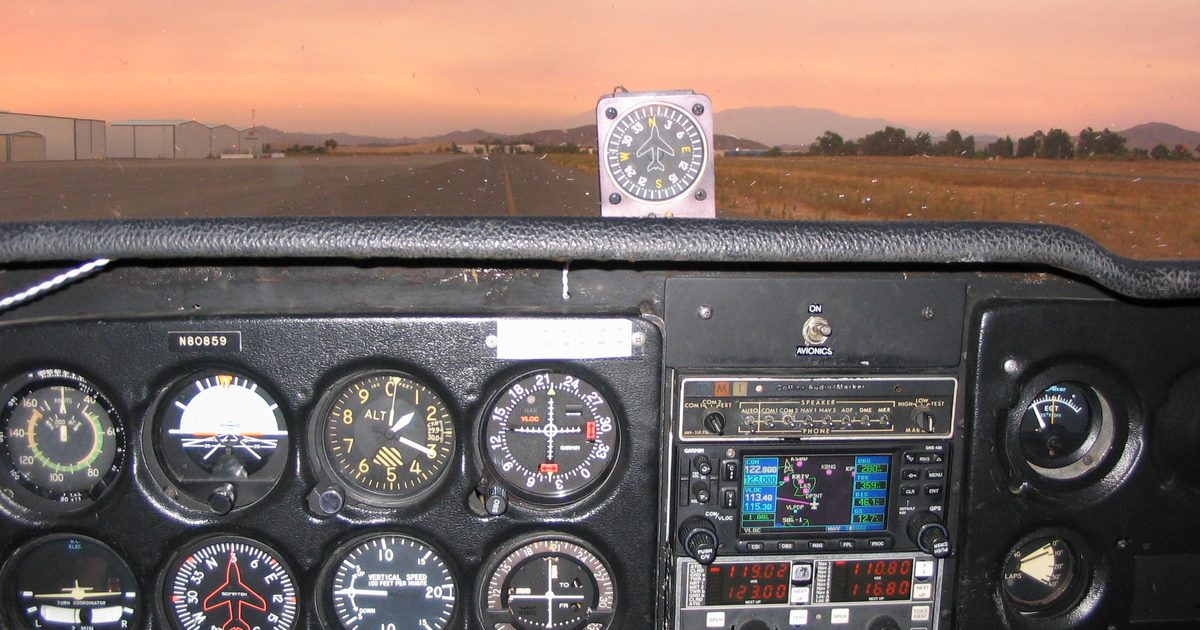
You spend your training logging every weakness, because your instructor is sitting right there naming them. Then you pass your test, the logbook gets a new entry that says "PIC" (pilot in command) instead of "dual", and the person who used to catch your mistakes is gone.
Most students assume the dangerous part of a flying career is training itself, since that is when you are least skilled. The data says something closer to the opposite: the accident risk rises after certification, not before, and it stays elevated for a specific, well-studied stretch of hours.
The Short Version
- A long-running idea in general aviation safety, sometimes called the "killing zone", places the highest accident risk somewhere in a pilot's first 50 to 350 total flight hours, not during initial training.
- The FAA's own research arm tested the idea statistically and found the pattern real but blurrier than the popular version, with elevated risk stretching much further than 350 hours.
- The mechanism is not a single failure. It is complacency (an unconscious drift) layered under overconfidence (a conscious, wrong judgement call), and the two feed each other.
- Kenya's training pipeline moves pilots from closely supervised circuits at Wilson into solo cross-country and, for many, straight into bush-strip and safari flying, exactly the terrain where this risk window and the highest-consequence environment overlap.
- The fix is not more talent. It is structure: deliberate recency, honest post-certification mentoring, and refusing to let "I passed" feel like "I'm finished learning".
What the "killing zone" actually claims
The term comes from Paul Craig's book of the same name, which argues that general aviation pilots face their highest accident risk somewhere between roughly 50 and 350 total flight hours. That is not the first few hours of training, when a student barely trusts themselves to taxi straight.
It is the period right after a licence, when a pilot has just enough competence to feel capable and not yet enough experience to know what they still cannot see.
The appeal of the idea is obvious to any instructor. New pilots keep making exactly this shape of mistake: a confident go/no-go call that an instructor would have overruled, made alone, for the first time, with no one in the right seat to say no.
The FAA tried to verify it, and the picture got messier, not cleaner
An idea this popular eventually gets tested properly. The FAA's Civil Aerospace Medical Institute did exactly that in a 2012 technical report, DOT/FAA/AM-12/15, "Predicting General Aviation Accident Frequency From Pilot Total Flight Hours", by Knecht.
The report fitted statistical models to decades of NTSB general aviation accident data and found that a gamma distribution describes the relationship between hours and accident frequency reasonably well. Its conclusion is not a clean confirmation of the 50-to-350-hour window.
Instead, it suggests the most reliable predictions actually hold across a much wider band, roughly 50 to 5,000 hours, and that the original killing zone concept may understate how far the elevated-risk period extends. A 2015 follow-up report, DOT/FAA/AM-15/3, "Predicting Accident Rates From General Aviation Pilot Total Flight Hours", pushed further into whether any single range of hours carries the most risk.
Here is the honest, slightly uncomfortable takeaway. The precise boundaries of the dangerous window are genuinely debated among people who study the numbers for a living.
What is not debated is the direction: risk is not flat across a flying career, it spikes after certification, and it takes a long time to fall back down.
Two different failures wearing the same mistake
"I got overconfident" is the explanation every pilot reaches for after a scare. It is usually only half right.
A 2010 FAASTeam safety notice, "Avoiding Airborne Pilot Deviations", defines complacency precisely as overconfidence that builds from repeated experience with an activity. AOPA's own flight-training writing, in "From Confidence to Complacency", separates the two more sharply than that definition suggests.
Complacency is largely subconscious. It is the slow erosion of a scan, a checklist item that gets skipped because it has never once mattered, a habit of assuming the aircraft will behave the way it always has.
Overconfidence is a conscious decision made with too much faith in your own judgement. It is choosing to depart into marginal weather because you flew through something similar once and it worked out.
The FAASTeam notice adds a detail worth sitting with: complacency is harder to notice than fatigue, because from the inside, everything feels like it is going fine right up until it is not. The same notice specifically warns instructors to watch for it in students who already have significant flight experience, not the nervous beginner who is actually paying close attention.
The FAA has not let this drop as a historical curiosity either. Its July/August 2025 Safety Briefing, issued after a general and business aviation "call to action" meeting, carried a blunt line from the agency's Deputy Administrator: complacency is the enemy of safety.
That is not a line written for airline pilots. It describes the exact drift a newly certificated private or commercial pilot experiences once the instructor's seat is empty.
Why Kenya's training pipeline walks straight into this window
None of this is abstract for a pilot training in Kenya, and the shape of the local pipeline makes the overlap worse than in most countries.
Supervision drops off exactly when the terrain gets harder
Early training happens in the controlled, familiar circuit at Wilson or a similar aerodrome, with an instructor beside you and a paved, well-marked runway below. The hours that follow certification are often the opposite on every axis: solo, unfamiliar, and frequently over murram or grass strips with no tower and no second opinion.
A pilot who has just cleared the easiest flying of their life is, for the first time, making every call alone over the hardest flying they have attempted.
Bush and safari flying arrives early, not late
Kenya's tourism geography means a meaningful share of newly rated pilots move quickly toward charter and safari work over the Mara and the coast, flying into the kind of unlicensed strips this site has covered elsewhere. That work is valuable experience, and it is also precisely the environment where a complacent scan or an overconfident go/no-go call has the least margin for error: shorter runways, wildlife on the strip, no radar, no backup aerodrome nearby.
The killing zone and the highest-consequence flying in the country are not separate problems here. For a lot of Kenyan pilots, they are the same few hundred hours.
The CPL hour-building window compounds the exposure
Pilots working toward a Kenyan CPL log a large share of the hours between PPL and the commercial rating through exactly this stretch of solo, self-directed flying. More hours logged in the danger window is not automatically more risk if those hours are flown deliberately, but it is more risk if they are flown on autopilot, so to speak, simply to build the number required.
What actually buys the risk down
Nothing here argues for more talent, because talent is not really the variable. Structure is.
- Treat the licence as a floor, not a ceiling. A pass means you met the minimum standard on the day you were tested, nothing more. The FAA's own complacency warnings are aimed squarely at pilots who already have "significant flight experience," which should tell you something about who is actually at risk.
- Keep an instructor in the loop on purpose, past the point you legally need one. A voluntary check flight before your first solo bush-strip trip, or before your first unfamiliar coastal route, costs an hour and buys back a second opinion you otherwise will not have.
- Re-run your personal minimums for the new environment, not the old one. The limits you set while training in the circuit were calibrated for the circuit. A murram strip in the Mara deserves its own, tighter set.
- Notice when a check stops feeling necessary. That specific feeling, "I don't really need to check this anymore, I know how it goes," is complacency announcing itself. Treat it as a prompt to slow down, not a sign you have arrived.
- Log hours with intent, not just volume. A CPL hour-building flight flown with a real weather brief and a real go/no-go decision teaches more than the same hour flown on a day you would have gone regardless.
Instructors: the endorsement is not the end of your job
Signing a student off, whether for first solo or a full licence, closes one responsibility and does not close all of them. A debrief culture that follows a pilot informally for their first year, a willingness to answer a call about an unfamiliar strip, and an honest conversation about where a graduate is now flying alone all extend the supervision that the research says matters most during exactly this period.
A good CFI (Certified Flight Instructor) who stays reachable after the test is doing more for a new pilot's safety than another hour of circuit work would have.
What pilots admit about this period, once you ask
Pilot forums have a recognisable thread about the first year or two after certification, and it rarely takes the shape of a dramatic near-miss story. It takes the shape of a slow confession.
The pattern that keeps showing up is a pilot describing a flight they would never have been allowed to fly during training, explaining afterward that it seemed completely reasonable at the time. The follow-up, almost always, is recognising only in hindsight that the reasoning leaned on a handful of hours of success rather than any real margin.
Nobody in those threads describes feeling reckless in the moment. That absence is the entire point: complacency and overconfidence do not announce themselves as risk-taking while they are happening, which is exactly why the research keeps finding the danger in this window rather than earlier, when every pilot still feels like a beginner.
AngaBrief's instructor review workflow is built around that gap, giving a CFI a structured way to flag a pattern across lessons rather than relying on memory alone. It is not a dispatch authority, and it never decides for anyone: the go/no-go call stays with the pilot in command and their instructor, always.
Key Takeaways
- The highest general aviation accident risk sits after certification, in roughly the first few hundred flight hours, not during training itself.
- FAA research confirms the pattern's direction but shows the risky window is wider and blurrier than the popular "50 to 350 hours" figure suggests.
- Complacency (subconscious drift) and overconfidence (a conscious bad call) are distinct failures that reinforce each other in exactly this period.
- Kenya's move from supervised circuit training straight into solo bush-strip and safari flying puts many pilots' highest-risk hours over the country's least forgiving terrain.
- Deliberate recency, voluntary check flights, and resetting personal minimums for new environments are what actually close the gap, not raw talent.