
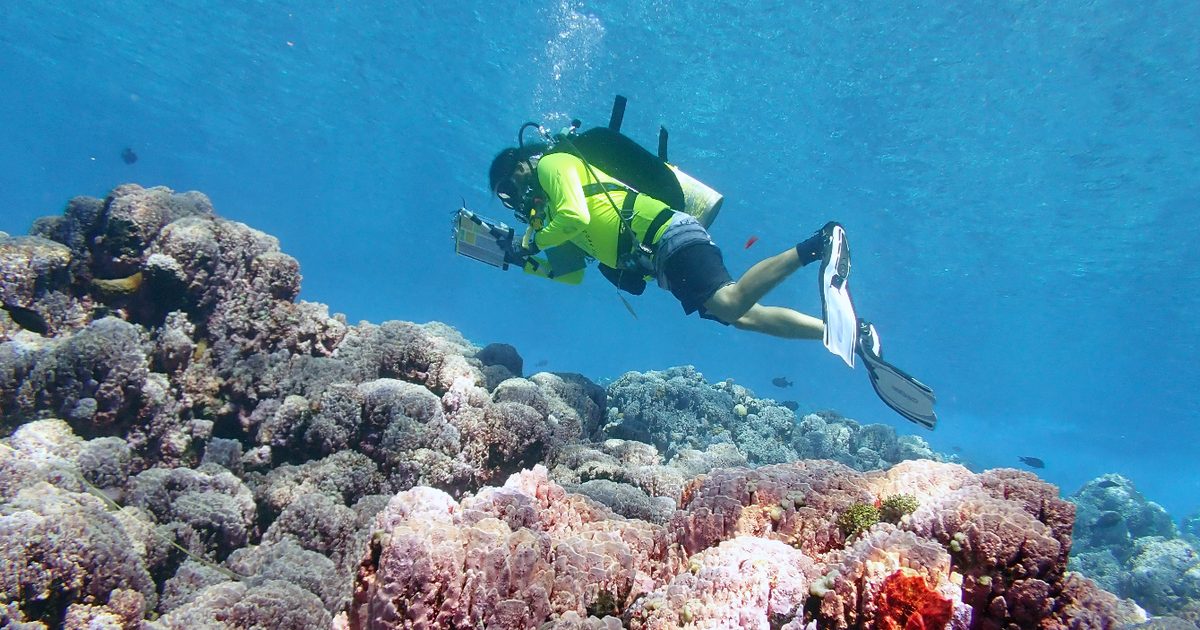
Picture the trip. A dive in the morning off Diani or Watamu, lunch on the beach, then an afternoon flight out of Ukunda or Malindi, climbing over the highlands towards Wilson or straight into a Mara airstrip at over 5,000 feet.
Nobody on that itinerary thinks of it as a medical decision. It is one, and Kenya's own geography makes it a harder one than the standard guidance was written for.
The Short Version
- Flying too soon after scuba diving can cause decompression sickness (DCS), because nitrogen absorbed underwater takes time to clear and lower pressure at altitude lets it form bubbles in the body.
- The FAA's published guidance is to wait at least 24 hours between diving and flying, and it warns that DCS can appear at cabin altitudes as low as 5,000 feet if too little time has passed.
- Kenya's coast-to-interior routes do not stay low. Wilson Airport sits at roughly 5,546 feet, and popular Mara airstrips sit between about 5,000 and 5,800 feet, which means cruise altitude on these legs is routinely well above the figures most diving-and-flying advice assumes.
- This is not a tourist-only problem. KCAA-approved flying schools operate training bases at Ukunda and Malindi, the same airstrips divers use, so student pilots and dive-holiday self-fly licence holders share the same runway and the same risk.
- IMSAFE's "Illness" line should cover this explicitly for anyone who dives. A fit, symptom-free pilot can still be carrying a DCS risk that only altitude will reveal.
What is actually happening in the body
Scuba diving loads your tissues with extra nitrogen, dissolved under the higher pressure of the water above you. Surface normally and your body sheds that nitrogen gradually, which is the entire point of dive tables and no-decompression limits.
Fly too soon afterwards and you add a second pressure drop on top of the first one. The FAA's safety brochure on Altitude-Induced Decompression Sickness is direct about the mechanism: reduced pressure lets the nitrogen still dissolved in your blood and tissues come out of solution and form bubbles, the same physical process that causes DCS in diving itself.
Those bubbles can lodge in joints, the spinal cord, or the inner ear, and the symptoms range from joint pain and dizziness to, in serious cases, paralysis. It is not a theoretical risk confined to deep technical diving.
It is a known consequence of ordinary recreational diving followed by flying too soon.
Why "a bit of altitude" is not the safety margin people assume
The instinct is to assume this only matters on long-haul flights in a pressurised jet climbing to 35,000 feet. That instinct is wrong, and it is wrong in a way that matters specifically for light aircraft.
The FAA brochure states plainly that altitude DCS is a risk every time you fly in an unpressurised aircraft above 18,000 feet, or at a lower altitude if you have been scuba diving beforehand. It goes further: DCS can occur during exposure to altitudes as low as 5,000 feet or less if too little time has passed since the dive.
Read that again in the context of a Cessna or Caravan climbing out of Ukunda. You do not need oxygen-mask altitudes for this risk to be live.
You need an unpressurised cabin and a dive within the last day, and most light aircraft operating in Kenya are unpressurised by default.
The guidance assumes routes that do not look like Kenya's
The FAA's Aeronautical Information Manual, in the section covering decompression sickness after scuba diving, sets out wait times before flying: at least 12 hours after diving that did not require a controlled decompression stop, and at least 24 hours after diving that did. Those figures are explicitly stated for flights up to 8,000 feet.
The FAA brochure is more conservative across the board and recommends at least 24 hours between any scuba dive and any flight, regardless of profile. Given how easy it is to misjudge your own dive profile after a relaxed holiday dive, 24 hours is the only sensible default to teach.
Here is the Kenyan problem. The 8,000-foot figure in the AIM describes a flight that stays low.
A flight out of the coast into Nairobi or the Mara does not stay low.
- Wilson Airport (HKNW) sits at roughly 5,546 feet AMSL on the ground. Cruise altitude to get there from the coast, clearing the terrain in between, runs comfortably higher again.
- Keekorok airstrip in the Mara sits at around 5,800 feet, and Olkiombo at close to 5,000 feet. A light aircraft flying there from Mombasa or Ukunda is not loitering at 2,000 feet. It is climbing to and sometimes above the altitudes the FAA's low-altitude figures were written around.
A diver who read a generic "wait 24 hours, flights under 8,000 feet are lower risk" summary online and applied it to a Mombasa-to-Mara hop has quietly stepped outside the assumption that made the summary feel reassuring in the first place.
This is a flying-school problem, not only a tourist problem
It would be easy to file this under "things safari operators should brief their guests on" and move on. That misses how directly this touches Kenyan flight training.
KCAA's approved training organisation lists show flying schools running bases directly at Ukunda Airstrip and Malindi Airport, the same strips that serve Diani and Watamu's dive tourism. Kenya School of Flying is one documented example, with bases including Wilson, Malindi, and Ukunda alongside its Nairobi operations.
That means the person doing a PPL cross-country solo out of Ukunda on a Saturday morning and the person loading dive gear into a taxi outside the same gate are using the same runway, the same circuit, and in some cases the same person.
A self-fly PPL or CPL holder who dives recreationally on the coast, then flies themselves or their family onward the same day, is not a hypothetical. It is a predictable pattern given where Kenya's training bases and dive sites sit.
Instructors based at coastal airstrips have a direct reason to raise this explicitly rather than assume it will come up. A student who dives for fun on a day off training is exactly the profile IMSAFE's "Illness" line was never written with in mind, because nothing about a day of diving makes a pilot feel unwell.
That is precisely the trap.
Charter and safari pilots: the professional version of the same risk
Tourists are not the only people in this picture. Kenya's coast supports a working population of charter and safari pilots who fly for a living and often live near, or socialise near, the same dive sites their passengers fly in to see.
A professional pilot who dives on a rest day and flies duty the next morning is making exactly the same calculation as the holidaymaker, except with passengers depending on their judgement rather than only their own safety at stake. Nothing in Kenyan duty-time or medical-fitness rules asks a pilot about a dive logged the day before, which means the only safeguard is the pilot's own honesty on the IMSAFE line, or a school and operator culture that asks the question out loud.
A chief pilot or accountable manager at a coast-based operator has a direct reason to put "recent diving" on the same footing as alcohol or medication on a fitness-to-fly declaration, rather than leaving it as an assumed common-sense item nobody actually states.
A self-check that actually catches it
IMSAFE's "I" asks whether you are suffering from any illness. Most students run through that line thinking about colds and stomach bugs, and a day of diving will not register.
Build the check so it cannot be missed. Before any flight, ask the specific question: have I dived with compressed air in the last 24 hours?
- If yes, and the flight stays low: the FAA's 24-hour rule still applies regardless of your planned altitude, because dive profiles and actual flight paths both drift from what was planned.
- If yes, and the route climbs towards the highlands or a Mara airstrip: treat the 24-hour minimum as a floor, not a target, given how far above 8,000 feet those routes typically sit.
- If symptoms appear after a dive-and-fly, even mild ones such as unusual joint ache, dizziness, or fatigue that feels disproportionate: the FAA brochure's advice is unambiguous. Do not fly again until cleared by an aviation medical examiner or a hyperbaric medicine specialist. This is a grounding matter, not a "monitor it" matter.
None of this requires special equipment. It requires asking the question before the walkaround instead of after take-off, when it is too late to change the plan.
What pilots say about this pattern
Search pilot forums for diving and flying and the shape of the discussion is consistent. Few people report a dramatic in-flight DCS event, because full-blown cases that happen mid-flight at low altitude in light aircraft are not common.
What comes up repeatedly instead is a quieter admission: pilots who are also recreational divers describing how easy it was to let the wait-time rule slide on holiday, when the diving was casual and the flight felt routine. The near-misses people describe are rarely about ignorance of the rule.
They are about the rule feeling optional in the moment, surrounded by people for whom it genuinely is optional, because they are not flying.
That gap between knowing a rule and applying it on a relaxed holiday, away from a training environment, is exactly where a flying school's briefing earns its keep.
What a CFI should actually do with this
Add one specific question to pre-flight briefings for any student or renter based at a coastal airstrip, or anyone you know dives recreationally: when did you last dive, and what was the profile.
Treat a positive answer inside 24 hours as an automatic conversation, not an automatic scrub. Sometimes the right call is to delay the lesson to the following day.
Other times it is simply to confirm the student genuinely waited the full 24 hours and to ask about the planned cruise altitude for that day's route. A good CFI (Certified Flight Instructor) does not need to memorise dive tables to ask the one question that matters.
A multi-day dive package, which is how most Diani and Watamu holidays are actually sold, makes this harder to judge than a single dive does. The FAA brochure's 24-hour figure is stated as a minimum regardless of profile, precisely because it is meant to cover the harder-to-judge cases rather than only the easiest one.
For schools running cross-country training through the Mara or between Wilson and the coast, this is worth a line in the student handbook rather than leaving it to come up by chance. AngaBrief's IMSAFE section allows an Illness entry to carry a note rather than a bare pass, which is useful for exactly this kind of situational risk that a plain yes-or-no checkbox would otherwise hide.
The tool only records the assessment. The go/no-go decision stays with the pilot in command and their instructor, always.
Key Takeaways
- Wait at least 24 hours between any scuba dive and any flight. The FAA's own brochure treats this as the safe default regardless of dive profile.
- DCS can occur at cabin altitudes as low as 5,000 feet after diving, not only at high jet cruise altitudes.
- Kenya's coast-to-interior routes commonly climb well above 8,000 feet, the ceiling most generic diving-and-flying advice assumes you will stay under.
- Flying schools at Ukunda and Malindi sit inside active dive-tourism areas, making this a real training-population risk, not an abstract one.
- Build "when did you last dive" into pre-flight checks explicitly. A fit-feeling pilot can still be carrying a real DCS risk.