
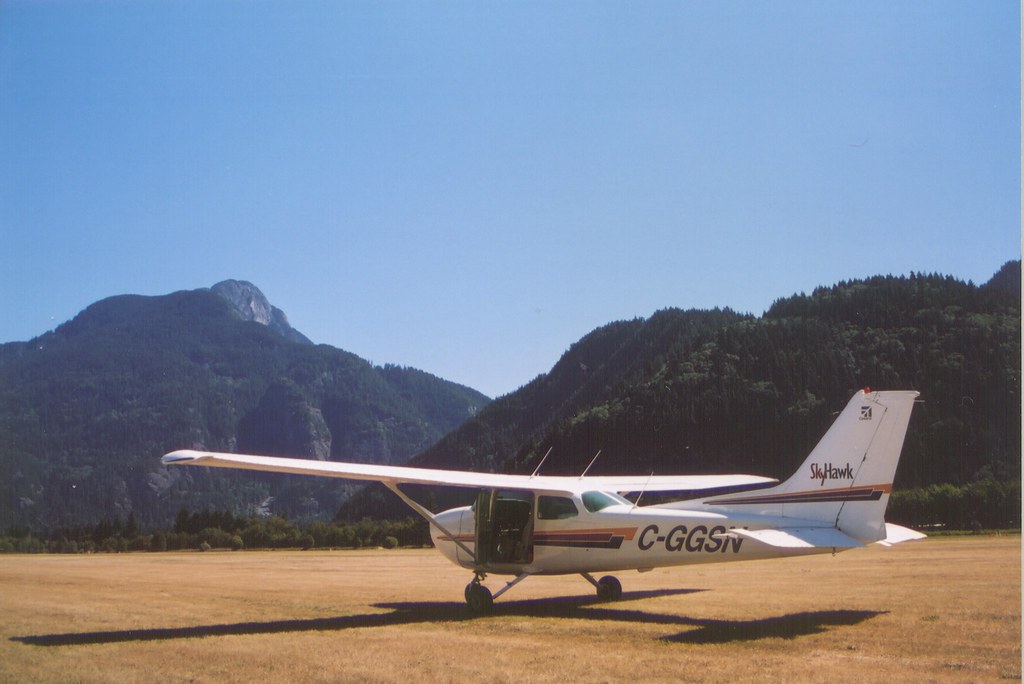
Every Wilson-based student learns the standard hazards early: the crosswind on the grass strip, Nairobi's Class C airspace overhead, a taxiway system busy enough that ATC expects a full readback every time. Fewer are told plainly what sits immediately south of the airport boundary.
Nairobi National Park is the only national park in the world inside a capital city, 117 square kilometres of open grassland carrying four of Africa's Big Five and more than 400 recorded bird species. Its fence line runs along Wilson's southern boundary, which means your climb-out and your approach both work airspace that a serious wildlife population also calls home.
An airport with a game park for a neighbour
The FAA's own guidance on airport siting, Advisory Circular 150/5200-33C, Hazardous Wildlife Attractants on or near Airports, treats open grassland holding large animal populations as exactly the kind of land use that draws raptors and other hazardous wildlife into approach and departure paths. It recommends five statute miles of separation between an airport's runways and an attractant of that kind wherever practical.
Wilson's runway threshold sits close enough to touch the fence. That is not a criticism of the airport, which did not choose its neighbour and has run a bird control programme for decades, but it is a fact every pilot flying there should carry consciously rather than absorb by accident.
Compare that to most other Kenyan aerodromes a student trains at. JKIA's approach paths cross ordinary suburban and agricultural land, and the upcountry strips have their own wildlife concerns but rarely a dense, protected wildlife population sitting directly off one runway end.
Wilson's specific geography does not just raise the odds of a strike. It raises the odds that the bird involved is large, because a national park sanctuary supports species a farm field or a suburb does not.
Why "just a bird" is the wrong mental model
The damage a bird strike does is not about the bird's size the way most students picture it. It is about kinetic energy, which rises with the square of speed, a relationship Transport Canada's wildlife hazard management guide sets out plainly in its own bird impact physics appendix.
A 20 percent increase in your airspeed raises the impact energy by roughly 44 percent for the same bird. That is why a strike on climb-out at Vy hurts more than the same bird taken during a slow, low circuit pass.
The FAA's own reporting programme, described in Advisory Circular 150/5200-32C, records that birds account for about 97 percent of all reported wildlife strikes, with terrestrial mammals and bats making up the rest. A windscreen can be penetrated by a bird strike, and general aviation guidance from the AOPA Air Safety Institute notes that even a windscreen a good few millimetres thick offers no guarantee against a large bird at speed.
Your trainer was never certified for this
Here is the detail most students never hear, and it matters more at Wilson than almost anywhere else you will fly. Transport-category aircraft certified under 14 CFR Part 25 must demonstrate their windscreen can withstand a four-pound bird strike at cruise speed without penetration, a standard set out in 14 CFR 25.631 and 25.775.
Light aircraft certified under Part 23, which is every C152, C172, and PA-28 on a Kenyan training line, carry no equivalent requirement. SKYbrary's summary of aircraft bird strike certification notes plainly that light aircraft and light helicopters have minimal to no certified bird strike resistance, even though they routinely operate at the low altitudes where birds are most concentrated.
That is not a design flaw to panic about. It is a fact that should change how seriously you treat avoidance, because the aircraft itself is not going to absorb the problem for you the way a transport-category jet is engineered to.
The specific birds sharing your circuit
Nairobi National Park's own recorded bird list includes white-backed vultures that breed inside the park boundary, along with Rüppell's, lappet-faced, and hooded vultures that visit to feed. Martial eagles, tawny eagles, long-crested eagles, crowned eagles, bateleurs, and secretarybirds are resident raptors as well, and none of them is a small animal.
Rüppell's griffon vulture deserves particular respect from anyone who flies near it. The species holds the confirmed altitude record for a bird strike, a 1973 collision at 37,000 feet over Abidjan documented in aviation history accounts of the incident, and it is listed Critically Endangered with roughly 2,000 breeding pairs estimated across Kenya according to the IUCN Red List assessment.
The reason a vulture can reach an airliner's cruise altitude is the same reason your instructor points out thermals over the Rift Valley escarpment. These birds are built to ride rising air for hours at a stretch, covering long distances on almost no wingbeats.
A soaring raptor over open savanna is not an occasional visitor passing through. It is doing exactly what its wing shape and its species evolved to do, in exactly the kind of open, thermal-generating terrain that a national park next to a runway provides.
Where and when the risk actually peaks
The FAA's Aeronautical Information Manual guidance on bird hazards notes that over 90 percent of reported strikes happen at or below 3,000 feet AGL, which covers essentially all of a Wilson circuit, climb-out, and approach. Waterfowl and large soaring birds are routinely seen well above that, so altitude is a reduction in risk, not an elimination of it.
Bird activity itself peaks at dawn and dusk, though the AIM notes that roughly 62 percent of actual reported strikes still happen in full daylight, simply because that is when most flying happens. The twilight window matters anyway, because it is also when visual detection is hardest, which compounds a period of already-elevated activity with reduced ability to see it coming.
What a real bird strike accident looks like
It is tempting to file bird strikes under "cosmetic damage" because most strikes are exactly that. The NTSB's report on Cessna 500 N113SH is the reminder that the tail of the distribution is fatal.
About two minutes after takeoff from Wiley Post Airport in March 2008, the aircraft struck one or more large birds, later identified through feather analysis as pelicans. The aircraft departed controlled flight, rolled through inverted, and struck the ground.
The NTSB's safety findings were not just about the birds. They pointed to gaps in wildlife hazard assessment near known attractants and the absence of published guidance for pilots on operational strategies to reduce bird strike damage risk, which is precisely the gap this article is trying to close for a Wilson-based pilot.
The three things that actually reduce your risk
None of this argues for avoiding Wilson, which is not realistic advice for the busiest aerodrome in East Africa. It argues for three specific, learnable habits.
First, if you see birds ahead in your flight path, climb rather than descend. Birds instinctively dive away from a perceived threat, which is why AOPA's pilot guidance is consistent on this point: pitching up gives the bird room to do what it is already going to do.
Second, treat the climb-out over the park boundary and the final approach across it as moments for an active vertical scan, not just the horizontal traffic scan you were taught for other aircraft. A soaring vulture at your altitude does not move like traffic and will not show up if you are only scanning the way you scan for aeroplanes.
Third, if you do strike a bird, report it. ICAO's aerodrome standards, the same framework KCAA aligns its own regulations against, require wildlife strike data collection precisely because a bird control programme is only as good as the strike data feeding it.
An unreported strike is a data point a bird management team never gets to act on.
Instructors: brief this before the first solo, not after a scare
A good CFI (Certified Flight Instructor) at a Wilson-based school has almost certainly seen a raptor closer than they would like at some point in their own flying. Few make a habit of briefing it as a named, standing item before a student's first solo circuits, rather than a story told once and half forgotten.
Naming it explicitly costs one sentence in a pre-solo brief: expect large soaring birds over the park boundary, scan for them vertically, and know that climbing beats descending if one is in your path. A student who hears that once, deliberately, is far more likely to actually scan than one who only picked it up as ambient hangar talk.
Kenya is not hypothetical about this
In May 2026, Kenya Airways experienced three separate bird strike incidents within a single month, including a flight forced back to Entebbe after a strike shortly after takeoff and a Cape Town-bound aircraft that landed with radome damage after a strike on approach. Those were airliners on different routes, not Wilson-based trainers, and drawing a direct line from a widebody incident to a C172 circuit would overstate the connection.
What that cluster of incidents does establish honestly is that bird strike in Kenyan airspace is a live, recurring operational reality, not a rare curiosity you read about happening somewhere else. A national aerodrome network sitting inside some of the most bird-dense terrain on the continent is not a system where this hazard is theoretical.
What pilots admit on the forums
Pilot forum threads on bird strikes have a recognisable shape wherever they happen. Someone describes a strike that caused no real damage, and the replies fill with near misses nobody reported at the time because nothing seemed to happen.
The pattern that recurs most is not the dramatic windscreen story. It is pilots admitting, well after the fact, that they had grown used to seeing raptors at circuit height near a specific aerodrome and had stopped actively scanning for them, right up until the flight where one was closer than expected.
The Short Version
- Wilson Airport's boundary runs directly against Nairobi National Park, a serious wildlife attractant by the FAA's own siting standards.
- Bird strike damage scales with the square of your airspeed, and over 90 percent of reported strikes happen at or below 3,000 feet AGL, which covers your circuit, climb-out, and approach.
- Vultures and eagles resident in and around the park are large, soaring birds built to ride thermals for hours, not incidental visitors.
- Climb rather than dive away from birds in your path, actively scan vertically near the park boundary, and report every strike so the data can be acted on.
- Kenya's May 2026 run of Kenya Airways bird strikes shows this hazard is current and recurring, not theoretical.
AngaBrief's PAVE assessment prompts a pilot to consider environmental hazards specific to the departure and arrival aerodromes on a flight, which for Wilson includes the wildlife risk this article covers. The tool records that consideration in the audit log; it does not make the go or no-go call, which stays with the pilot in command and their instructor, always.
Key Takeaways
- Nairobi National Park's boundary against Wilson's runways makes bird strike a standing operational hazard, not an occasional one.
- Impact energy rises with the square of airspeed, so a strike at climb speed is far worse than the same bird at a slow circuit pass.
- Climb, do not dive, away from birds in your flight path, and scan vertically near the park boundary rather than relying on a horizontal traffic scan alone.
- Report every strike. Bird control programmes are only as effective as the data feeding them.