
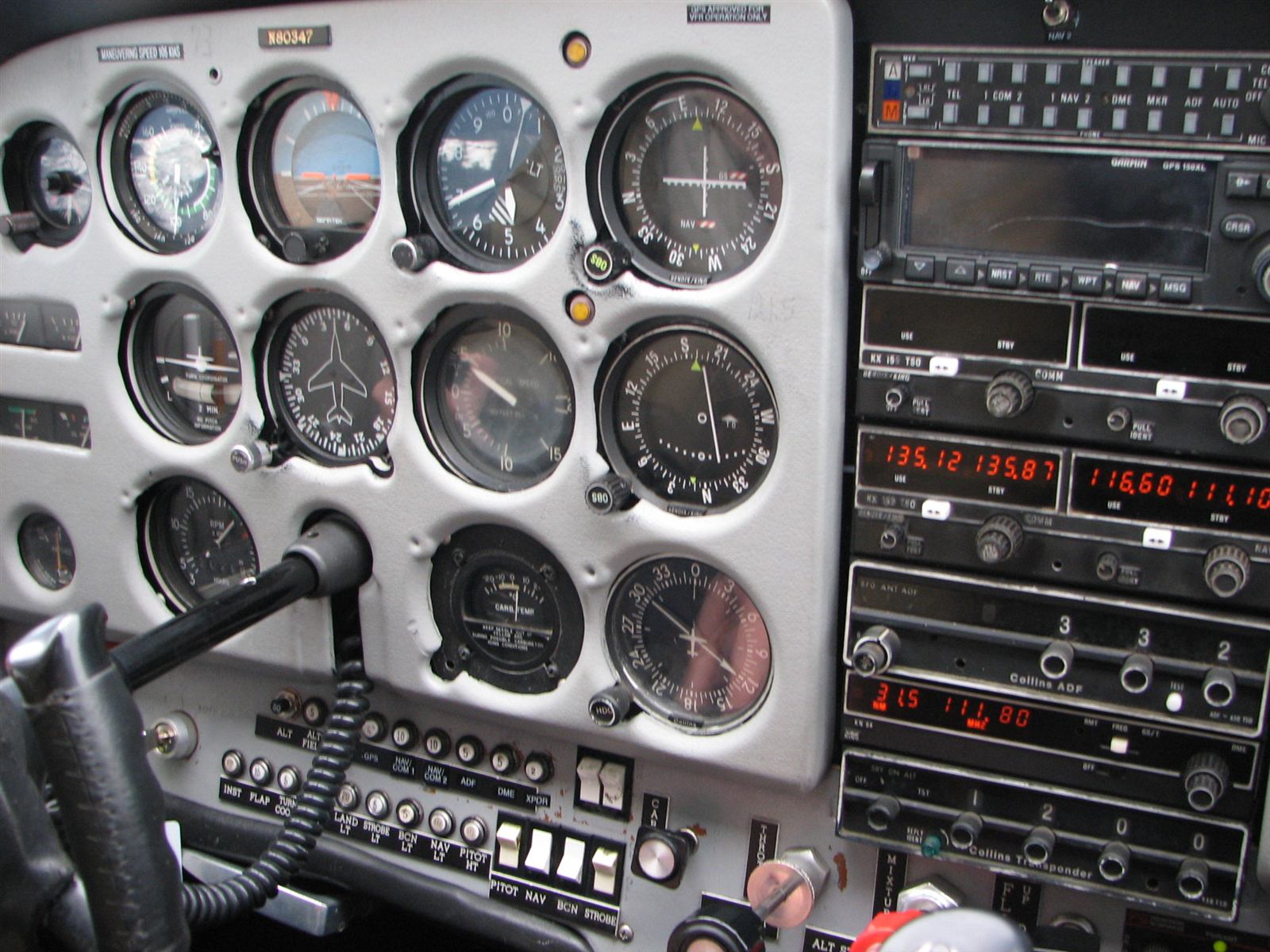
It is a hot Saturday morning at Wilson. The trainer has been parked outside since Thursday. The student has done a careful walkaround, the fuel is checked, the briefing was good. Power goes in, the aircraft starts to roll, and the instructor glances at the panel. The airspeed indicator is still sitting on zero.
This is the good version of the story. A blocked pitot tube has been caught at 20 knots on a long runway, with the throttle still in the pilot's hand. The bad version is the one where nobody looks at the needle until the aircraft is already off the ground.
The Short Version
- The airspeed indicator, altimeter and vertical speed indicator all work from air pressure taken at a few small openings: the pitot tube and the static port or ports. A small obstruction in either can make an instrument lie.
- Common culprits named by AOPA are insects, covers or tape left on after washing, and ice.
- A blocked pitot tube does not announce itself on the ground. You find it by looking at the airspeed indicator when the roll begins.
- The most useful defence is cheap: a walkaround that treats the pitot tube and static ports as items to inspect, not items to assume.
- If the instruments disagree with each other, or with what the aircraft is doing, fly the aircraft by attitude and power and look outside. Do not argue with the airspeed indicator.
What the system actually does
Three of the flight instruments you rely on most are not electrical sensors. They are pressure gauges. The AOPA article on how the pitot-static system works is a good plain-language starting point.
The short version: the pitot tube faces into the airflow and feeds the airspeed indicator. The static port or ports sample ambient air pressure and feed the airspeed indicator, the altimeter and the vertical speed indicator. If something plugs one of those openings, the instrument keeps working perfectly, on the wrong pressure.
That last point is the dangerous one. A failed vacuum pump or a flagged gyro tends to show itself. A blocked pitot tube just gives you a smooth, confident, wrong airspeed.
How a blockage shows up
AOPA's piece on pitot-static system failures describes the patterns, and they are worth knowing by heart because they differ.
- Pitot tube blocked, drain hole open: the airspeed indicator drops towards zero, because the pressure inside the system bleeds away through the drain hole. Only the airspeed indicator is affected.
- Static port blocked: the altimeter freezes at the altitude where the blockage occurred, the vertical speed indicator reads zero, and the airspeed indicator keeps working but is inaccurate. It reads progressively low as you climb above the blockage altitude and progressively high as you descend below it.
The practical lesson is that a climb with a frozen altimeter and a vertical speed indicator stuck on zero is not a coincidence of two instrument failures. It is one static problem showing up in several places.
Birgenair 301: the case everyone cites
The accident most often used to illustrate pitot blockage is Birgenair Flight 301, which crashed after take-off from Puerto Plata in the Dominican Republic in February 1996. The summary of the investigation attributes the loss to the crew's response to incorrect airspeed information from a pitot tube that investigators believed was blocked, most likely by a wasp nest built while the aircraft sat on the ramp without pitot covers fitted.
A Newsweek retrospective makes the same point and adds a detail that matters for this post: the pitot tubes were never recovered, so the wasp explanation was the most probable cause rather than a proven one. Treat it as a well-supported inference, not a certainty.
Two things carry over to a C152 or C172 on a Kenyan ramp, and neither depends on how big the aircraft is.
- A blockage was not visible during the pre-departure stage. The effect only becomes apparent once the aircraft is moving, so the chance to detect it is the take-off roll.
- The response to the bad data, not just the bad data, did the damage. A crew that believed an instrument over what the aircraft was doing was in trouble.
Your trainer is a very different aircraft, but the human factor is identical. We trust the needle.
It is not only insects
The same AOPA source lists several ordinary causes, and most of them are about people, not nature.
- Covers left on. A pitot cover that stays on through the walkaround blocks the tube completely.
- Tape on the static ports. AOPA notes that it is not uncommon for ports to be taped over while the aircraft is washed, and for the tape to stay there afterwards.
- Insects, dirt and nest material. A parked aircraft with open tubes is an inviting space. Reporting on pitot blockage notes that this is a recurring problem, not a one-off event from the 1990s.
- Ice. AOPA describes ice as the most frequent culprit, which is why pitot tubes and many static ports are heated. A heater that is switched off, or one that is not working, is a separate thing to check.
Kenyan school fleets spend a lot of time parked outdoors between lessons, and an aircraft that sat through a long weekend or a rainy week is exactly the aircraft that deserves a closer look at the tube. That is a reasoned risk, not a statistic: we have no Kenyan figure for how often this happens, and we are not going to invent one.
The checks that catch it
Nothing here needs special equipment. It needs the habit of doing each step on purpose, every time.
- Walkaround. Find the pitot tube and the static port or ports on that specific aircraft type. Confirm covers and tape are off, the openings are clear, and the tube is not bent or damaged. Use your eyes and, if the tube is reachable and your school allows it, a torch. Do not blow into a pitot or static opening: AOPA warns that doing so can damage the instruments, and a blocked opening should be cleared by a mechanic.
- Remove-before-flight discipline. Count your covers and streamers out and count them back. Ground crew who wash the aircraft should tell the next pilot what they covered.
- Pitot heat. Where fitted, follow your checklist for testing it. Know your aircraft's procedure instead of improvising.
- Take-off roll. This is the single most important check. Confirm the airspeed indicator comes alive early in the roll and keeps increasing. AOPA's guidance is to visually confirm the indicator is working once the roll begins. If it is not, reject the take-off while you still have runway.
- Climb and cruise cross-check. Compare the airspeed indicator with groundspeed from a GPS, and the altimeter with your expected altitude. AOPA's example is a rapidly falling airspeed on the indicator while the GPS disagrees, which points at the pitot-static system.
If it fails in the air
The first job is the one every instructor repeats: fly the aircraft. Set a known attitude and power setting for the phase of flight, which you should already know from training, and keep control.
Then work through what the symptoms are telling you. If the altimeter and vertical speed indicator have stopped responding and your aircraft has an alternate static source, selecting it is the standard answer, and the AOPA article lists it. Use your aircraft's flight manual for the exact procedure, because it differs between types and not every training aircraft has one.
In visual conditions, AOPA's advice is plain: look outside and land as soon as practicable. That fits a VFR student pilot well. You have a horizon, a runway and a known power setting. A blocked instrument becomes an inconvenience, not an emergency, provided you stay visual and do not chase the needle.
Tell the controller or the radio station what you have, and land. Then write it up properly in the tech log, because the next pilot needs to know and the engineer needs to find it. If you want more on that habit, see our post on the aircraft tech log.
For instructors and safety managers
Blockage is a good example of a hazard that the pre-flight system either catches or does not. Three small changes help.
- Make the take-off airspeed check an explicit item in your student briefing, and call it out aloud: "airspeed alive."
- Require that anyone who covers or tapes the pitot or static openings, for washing or for storage, logs it, and that the pilot's checklist includes confirming they are clear.
- Run a simulated blocked-instrument exercise on a dual flight in good weather. The FAA required pitot blockage scenarios in airline pilot training after the Birgenair accident, and a light-aircraft version costs you five minutes and a covered instrument.
AngaBrief's aircraft step in the pre-flight assessment asks whether the aircraft has known defects, and a known pitot-static issue counts as one. AngaBrief is not a dispatch authority. The final go/no-go decision, and the decision to abort a take-off roll, always belong to the pilot in command.
Key Takeaways
- The airspeed indicator, altimeter and vertical speed indicator read air pressure from small openings. When those openings block, the instruments keep working and give wrong answers.
- A blocked pitot tube with an open drain hole drags the airspeed indicator towards zero. A blocked static port freezes the altimeter and the vertical speed indicator.
- Causes are mostly ordinary: insects, covers or tape left on, and ice.
- Birgenair 301 shows the human factor. The investigation pointed to a probable pitot blockage and to the crew's response to bad airspeed data.
- The take-off roll airspeed check is the cheapest and most valuable defence. If the indicator is not alive, reject.
- In visual conditions, fly attitude and power, look outside and land as soon as practicable.