
Field notes
AngaBrief is live for Kenyan flight schools.
10 May 2026 · 4 min read · AngaBrief
Every KCAA-licensed Approved Training Organisation in Kenya is required to demonstrate, on demand, that a structured pre-flight risk assessment preceded each training flight on its books. The artefact has historically been a paper checklist on the kneeboard, signed by the instructor, filed in an annual binder, and produced when the inspector arrives.
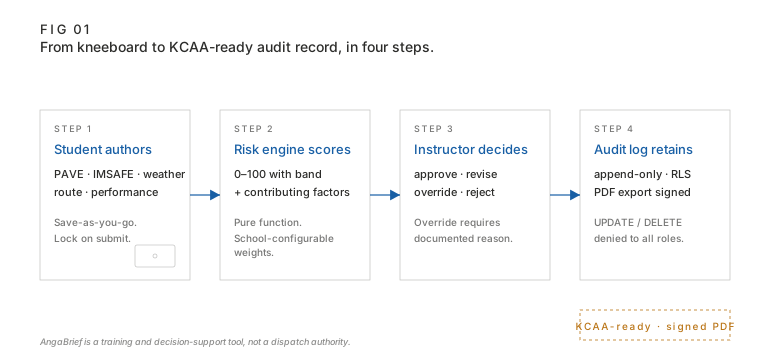
AngaBrief replaces that workflow without changing what the regulator sees. Students fill the same PAVE and IMSAFE prompts in a structured form on their phone. Instructors approve, request revision, or override — with documented reasoning — from the same device. An append-only audit log records every decision, exportable as a PDF that an examiner can sign without further translation.
What the v1 release covers
A student opens the assessment wizard, selects an aircraft and a route from the seeded AIP Kenya aerodrome database, and works through eight steps: flight details, aircraft, aerodromes and route, IMSAFE, PAVE Pilot, PAVE Aircraft, environment, and external pressures. The risk engine — a pure function with explicit weights documented in the school's settings — returns a 0–100 score banded as low / elevated / high / do not fly.
Each banded score appears beside its contributing factors. The score is never displayed without the operational reasons that produced it. That transparency is non-negotiable; it is the difference between a tool a PIC trusts and a black box they ignore.
On submission, the assessment locks. The student cannot edit it. The instructor receives it in a queue, decides, and the decision becomes a permanent audit-log entry. Subsequent edits to the assessment are prohibited at the database level — not just at the application level. Even a superadmin cannot rewrite history.
Cross-country route briefing
Cross-country pre-flight in Kenya needs more than departure and destination ICAOs. KCAA cross-country examiners look for a leg-by-leg breakdown — distance, true track, ETE, and a fuel margin against the aircraft's endurance. Step 3 of the wizard now produces that automatically.
The student enters intermediate waypoints in flight order. AngaBrief looks each one up in the seeded aerodrome database, computes great-circle distance and true track per leg, derives ETE from the aircraft type's cruise speed, and totals the fuel required. If the total exceeds 85% of the entered endurance, the briefing flags it on screen, in the assessment view, and on the exported PDF.
The wizard collects two alternates: a destination alternate (a fallback near the destination) and an en-route alternate (a divert aerodrome along the route). KCAA cross-country examiners ask for both — the briefing records both as separate ICAO references in the assessment record and on the audit log.
What v1 does not do
AngaBrief is deliberately bounded. The following are excluded from v1 and will not be retrofitted as side features:
- No automatic enroute weather. Manual METAR entry only, with an optional "fetch live" button that pulls the most recent METAR for the departure aerodrome from NOAA. The PIC remains the source of truth on weather, briefed against KMD products. AngaBrief inserts no layer between the operator and the regulator's accepted weather source.
- No POH digitisation. Cruise speed and fuel burn defaults are general-aviation averages by aircraft type code. The POH remains authoritative; defaults can be overridden per assessment.
- No offline-first PWA. The app installs as a Progressive Web App on Chrome and Safari, caches the wizard shell, and queues draft saves while a phone is on the apron without 4G — but submission, instructor approval, and audit-log writes require a connection. Final go/no-go is not a state that can sit in an offline queue.
- No multi-engine, no IFR airways planning, no STOL-specific minima. Single-engine VFR is the v1 envelope.
These limits are documented because the readership includes a regulator. Scope discipline is part of the trust model.
How the audit log works
Every state change writes a row to audit_events. INSERT is allowed via
SECURITY DEFINER trigger functions; UPDATE and DELETE are denied to every
role, including superadmin, at the database level. The export endpoint
produces a signed PDF in the school's storage bucket, with the regulatory
disclaimer stamped on every page and the AIP cycle reference on the
aerodrome data used at the time of submission.
The append-only property is enforced by Row-Level Security policies in PostgreSQL, not by application code. An attacker who reaches the application layer cannot rewrite audit history. This is the legal artefact for KCAA inspections; its integrity is the load-bearing claim of the entire product.
Disclaimer
AngaBrief is a training and decision-support tool. It is not a dispatch authority. Final go/no-go authority rests with the Pilot in Command and the assigned Flight Instructor in accordance with KCAA regulations. AngaBrief does not replace official weather briefings, NOTAM checks, aircraft documentation review, or instructor judgement.